









Thailand vs Cambodia: Military Might Amid Border Tensions
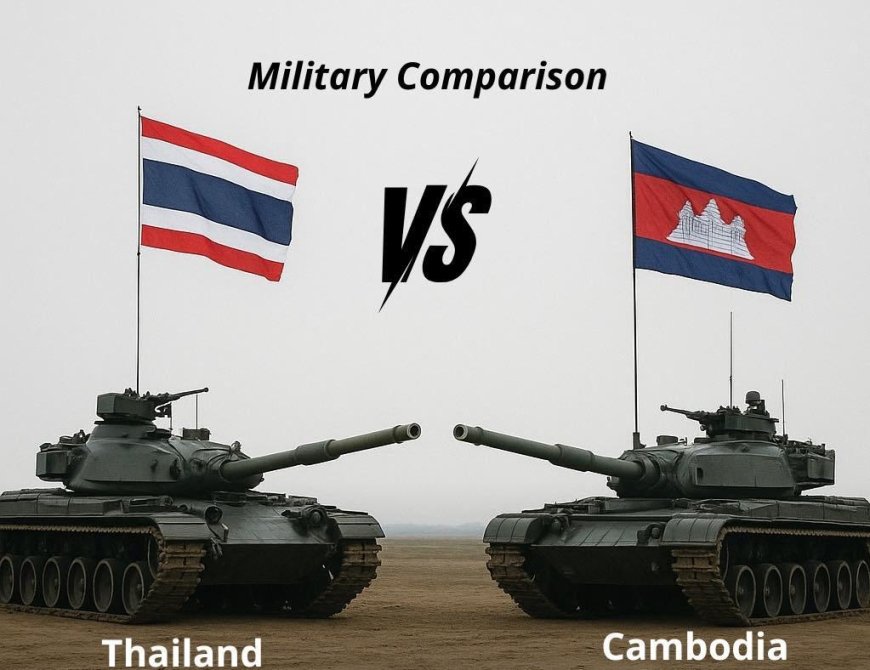
Amid ongoing tensions and historical disputes along their shared border, particularly near the Preah Vihear temple, Thailand and Cambodia’s military capacities paint a stark contrast. A comparison of their defense capabilities shows Thailand holds a significant edge in virtually all categories—budget, personnel, firepower, and global standing.
Budgets & Manpower
Thailand’s defense budget stands at $5.89 billion, supporting over 606,000 personnel, including 360,850 active in the army. Cambodia, in comparison, allocates $860 million to its military, with a total force of 231,000 personnel, most of whom (221,000) are in the army. The disparity in funding alone reflects Thailand’s far greater investment in defense infrastructure and technology.
Land Power
Both nations claim over 600 tanks—Thailand with 635 and Cambodia slightly more with 644. However, Thailand’s edge comes in mechanization and support systems, boasting 16,935 armored fighting vehicles (AFVs) and 665 artillery units. Cambodia, while maintaining 896 artillery units, lacks the diverse vehicle fleet of its neighbor, reducing its mobility and tactical flexibility on the battlefield.
Air Superiority
The air domain is perhaps the clearest indicator of imbalance. Thailand’s air force comprises 46,000 personnel and a fleet that includes 72 fighter jets, such as F-16s and Swedish Gripens, along with 258 helicopters. Cambodia, with only 1,500 personnel, has no fighter jets, relying solely on 10 transport planes and 21 helicopters. This effectively grants Thailand full air superiority in any potential conflict.
Naval Strength
Thailand also dominates at sea with 70,000 naval personnel, an aircraft carrier, and a well-rounded fleet that includes 7 frigates, 6 corvettes, 49 patrol vessels, and 14 landing craft. Cambodia’s navy consists of 2,800 personnel, 20 patrol vessels, and just 1 landing craft, with limited operational reach.
Thailand’s Marine Corps (23,000 strong) and naval aviation wing equipped with UAVs and helicopters further extend its amphibious and coastal capabilities.
Global Firepower Ranking
Reflecting this disparity, Thailand ranks 25th globally in military strength according to Global Firepower, while Cambodia ranks 95th. These numbers highlight not only the size and equipment gap but also the modernity and strategic reach of Thailand’s forces compared to Cambodia’s largely static defense model.
What This Means for Regional Stability
Although both nations maintain diplomatic relations, border incidents and nationalist sentiments occasionally reignite old tensions. Thailand’s superior military capability means any confrontation would be heavily one-sided, but it also places the onus on Bangkok to manage disputes with restraint.
Military analysts argue that such imbalances, if not tempered with diplomacy and regional cooperation, could escalate minor border skirmishes into more serious confrontations. ASEAN frameworks and confidence-building measures remain critical to ensuring peace, especially as nationalistic politics sometimes override cooler heads.
In an era of shifting regional dynamics, both countries are reminded that military power must be paired with mature diplomacy, lest history repeat itself.